The local SEO agency that gets you into the map pack
When someone nearby searches “[service] near me,” you are either in the top three on Google Maps or you are invisible. We get you into the 3-pack through your Google Business Profile, reviews, and local authority, then measure it in calls and bookings instead of ranking screenshots. That is the whole job.
FactoryJet is a US-focused local SEO company whose local SEO experts get your business into the Google map pack and Google Maps for “near me” searches. We optimize your Google Business Profile, fix NAP consistency at the citation aggregators, build reviews, and ship schema.org LocalBusiness structured data on every location page. Calls and direction requests come back as GA4 events, so the result is reported in bookings instead of rankings. Founder-led and month-to-month.
What local search looks like right now
Three figures worth knowing before you spend a month on local SEO. Each one links to the source it came from, so you can check it rather than take our word for it.
Share of consumers who read reviews for local businesses. 41% now say they always read them before choosing, up from 29% a year earlier.
BrightLocal Local Consumer Review SurveyShare of consumers using ChatGPT and other generative AI tools to find local businesses, up from 6% a year earlier. That makes AI the third most common source of a local recommendation.
BrightLocal Local Consumer Review SurveyThe Largest Contentful Paint threshold Google publishes for a good page experience, alongside Interaction to Next Paint under 200 ms and Cumulative Layout Shift under 0.1. Your location pages get held to the same bar.
Core Web Vitals thresholds, web.devThree signals decide who Google puts on the map
Every map-pack ranking comes down to the same three things, and Google says so itself in its Business Profile ranking documentation: local results are ranked mainly on relevance, distance, and prominence. We work all three, and lead with the two you can actually control.
Proximity
How close you are to the searcher. Google calls this one distance. Partly fixed, but the right service-area setup on your Google Business Profile widens the radius you can win.
Profile + service-area setupRelevance
How well your profile and pages match the search. Your category, services, and content do the heavy lifting.
Category + local contentProminence
How well known you are. Google names two inputs outright: how many sites link to you, and how many reviews you have. So reviews, citations, and local links are where the work goes.
Reviews + citations + linksYour local growth engine
Expert local SEO services, built around the four things that move map-pack rankings: your profile, your reviews, your citations, and local authority.
Google Business Profile
Categories, services, posts, photos, and Q and A tuned for Google Maps SEO so you rank in the map pack. Your profile is the single biggest signal Google reads, so it gets the most attention.
Reviews & reputation
Fresh, keyword-rich reviews and on-brand responses. The signal weighed most after your profile.
Citations & consistency
Consistent name, address, and phone across every directory, with duplicates killed.
Local content & links
Location and service pages that answer “near me” intent, plus local links and press that build real prominence across your whole service area.

The 14 checks we run in the first two weeks
Ordered by impact, top to bottom. This is the order we work in, and it is the same list you can hold any other local SEO company to.
- 1Primary category on your Google Business Profile.
The one field that moves the most on the whole profile. A wrong primary category keeps you out of the map pack for the term you care about, however many reviews you have.
- 2Secondary categories, services, and attributes.
Google matches these against the wording of the search. We fill every field that genuinely applies and remove the ones dragging you into queries you cannot win.
- 3NAP consistency at the aggregator, not the directory.
In the US most directory listings trace back to a few data aggregators. We correct the aggregator record first, then the copies, then suppress duplicates. Fixing forty directories by hand is the slow way.
- 4Apple Business Connect and Bing Places.
BrightLocal recorded Apple Maps usage for local recommendations climbing from 14% to 27% in a year. Both listings are free, take about an hour, and most businesses have never claimed either.
- 5Review volume, recency, and response rate.
Google names review count as a prominence input in its own documentation. We wire a request flow through the tools you already pay for, or through n8n, Zapier, or Make.com if you have none, and answer every review.
- 6schema.org LocalBusiness markup in JSON-LD.
Each location page ships with structured data carrying address, hours, phone, and geo coordinates. We write the JSON-LD to Google’s published LocalBusiness guidance, then validate the schema markup before it goes live.
- 7Location pages that are not clones of each other.
One page per location or service area, each genuinely different. Near-duplicate location pages get filtered out of the index and burn the crawl budget you wanted spent on the pages that convert. Content pruning usually comes before writing anything new.
- 8Internal linking from your strongest pages down.
Service pages that already hold topical authority should be passing it to the local pages. Internal linking costs nothing and most local sites still leave every location page one orphaned click from nowhere.
- 9Canonical tags and single-hop 301 redirects.
Retired location URLs, tracking parameters, and www variants split your signals. We build a redirect map, ship each 301 redirect as a single hop, and set a self-referencing canonical tag on everything that stays.
- 10Core Web Vitals measured on a phone.
Map-pack traffic arrives on mobile, on a cell connection. We check Largest Contentful Paint, Interaction to Next Paint, and Cumulative Layout Shift in field data, not just a Lighthouse run on a laptop.
- 11Google Search Console coverage and query data.
Search Console shows which local queries you already surface for and which location pages Google decided not to index. In a technical SEO audit that is where the fastest wins sit, and where you catch crawl budget draining into pages nobody searches for.
- 12GA4 and Google Tag Manager wired to calls, not sessions.
Click-to-call, direction requests, and form submits become named GA4 events through Google Tag Manager. Without that, nobody can honestly tell you whether local SEO worked.
- 13Profile posts, fresh photos, and Q and A.
An active Google Business Profile outranks a dormant one carrying the same reviews. Posts, current photos, and seeded questions are the cheapest ongoing signal available to you.
- 14Local links and mentions that are not directories.
Chamber pages, local press, sponsorships, supplier listings. A handful of genuine local links builds more prominence than another hundred citations on sites nobody visits.
Most of that overlaps with our wider SEO services, because local SEO is ordinary SEO with a geography constraint bolted on. The free SEO audit runs this same list and hands you the findings whether or not you hire us. To see what this work usually costs, job by job, read our local SEO cost guide. Single-location owners usually start with small business SEO. We also offer vertical programs including dental SEO, healthcare SEO and law firm SEO. If you also sell online, the product and collection side sits on ecommerce SEO, and product reviews collected in Yotpo or Judge.me are a separate stream from your Google Business Profile reviews, so do not let anyone report them as one number.
Because 45% of consumers now ask an AI tool for local recommendations, the profile, review, and structured data signals we build here are the same ones that feed AI SEO and AI search optimization. And if the bottleneck turns out to be the site itself rather than the profile, that is a web design problem. We will say so instead of billing you for another month of tuning a site that cannot be tuned.
We also publish a metro-specific SEO page where the competitor set and the review bar differ enough to matter: Austin, Dallas, Chicago, Los Angeles, Boston, Phoenix, San Diego, and Las Vegas. Start there if you are in one of them.
Next step
Not showing in the map pack?
Send us your business name and city. We will check your profile, your categories and your competitors, and tell you what is holding you down.
How the options compare
Four honest ways to do local SEO, including not hiring us
Local SEO is not something only an agency can do, and we are one of four workable options here. With one location and the hours to spare, doing it yourself genuinely works. With twenty locations and no time, it does not. A listings tool solves one part of this properly and none of the rest. Find the row that matters most to you and decide on that.
| FactoryJet | Doing it yourself | A listings tool | A full agency retainer | |
|---|---|---|---|---|
| Who does the work. | The founder scopes it and stays on the account. | You, in the hours left after running the business. | Software. Nobody reads the output except you. | Usually an account manager, with a strategist on the kickoff call. |
| Google Business Profile. | Categories, services, attributes, posts, photos, and Q and A, reviewed weekly. | Simple to set up, easy to leave dormant for months. | Syncs name, address, phone, and hours. Categories and posts stay on you. | Set up properly at onboarding, then often revisited quarterly. |
| Citations and NAP consistency. | Aggregator record first, then the copies, then duplicate suppression. | Doable, but hunting duplicates by hand takes weeks. | This is what these tools are genuinely best at. | Frequently subcontracted to the same listings tools. |
| Reviews. | Request flow through your existing tools, n8n, Zapier, or a Twilio number, plus a written response on every review. | Works if you remember to ask. Most owners forget. | Monitoring and alerts. Asking is still manual. | Usually included, sometimes priced as an add-on. |
| Location pages and schema. | Unique pages with schema.org LocalBusiness structured data in JSON-LD, validated before launch. | Realistic only if you already write for the web. | Not covered. | Covered, though the schema markup is often skipped. |
| Site speed. | Core Web Vitals checked on mobile against the published Largest Contentful Paint, Interaction to Next Paint, and Cumulative Layout Shift thresholds. | A Lighthouse score you can run, and then what. | Not covered. | Flagged in the audit and handed to your developer. |
| What gets reported. | Calls, direction requests, and form submits as GA4 events through Google Tag Manager, in a Looker Studio view you keep. | Whatever you check yourself inside Google Business Profile. | Listing accuracy and review counts. | Rankings and traffic, sometimes calls. |
| Commitment. | Month to month. | Your own hours, which is the real cost. | An annual subscription in most cases. | Six to twelve month lock-in is still common. |
Estimate Your Local SEO Opportunity
Calculate estimated local search customer traffic, map pack phone calls, and revenue growth for your service areas.
Google Map Pack Opportunity Estimator
Discover how many high-intent commercial calls and qualified client inquiries your competitors win every month from top 3 Map Pack rankings:
Projected revenue captured by ascending into Top 3 Google Map Pack.
Why local businesses choose FactoryJet
Whether you run one location or twenty, here is how a founder-led local SEO agency stacks up against a typical agency or doing it yourself with tools.
The systems your local visibility actually runs on
Local SEO is not one dashboard. Your visibility sits across systems that do not talk to each other, and the gaps are where rankings leak. Here is each one, and what it is for.
- Google Business Profile.
Categories, services, attributes, hours, posts, photos, and Q and A. The single largest input into where you sit in the map pack, and the one most owners set up once and never revisit.
- Google Search Console.
Which local queries you already appear for, which location pages are indexed, and which Google quietly dropped. We pull coverage and query data monthly, plus log file analysis when a big multi-location site is not getting crawled.
- Google Maps.
Where the profile is actually seen. Photos, directions, and reviews render here first, and a Maps result behaves nothing like a desktop search page.
- Apple Business Connect.
Apple Maps listings for iPhone users, including the place card Siri reads from. Free to claim, and now too widely used to skip.
- Bing Places.
Smaller than Google, still free, and it feeds answer engines that do not crawl Google directly. Worth the hour it takes.
- Citation aggregators.
The handful of US data providers that most directories syndicate from. Correcting the source record propagates outward. Correcting directories one at a time does not.
- GA4 and Google Tag Manager.
Google Analytics 4 is where calls, direction requests, and form submits land as named events, fired through Google Tag Manager. Where the site allows it we move to server-side tracking with consent mode, so your first-party data survives the browser changes.
- Google Merchant Center.
Only relevant if you carry stock. Local inventory feeds put your actual shelf into nearby searches. If your store runs on Shopify or WooCommerce, the feed is usually already sitting there unused.
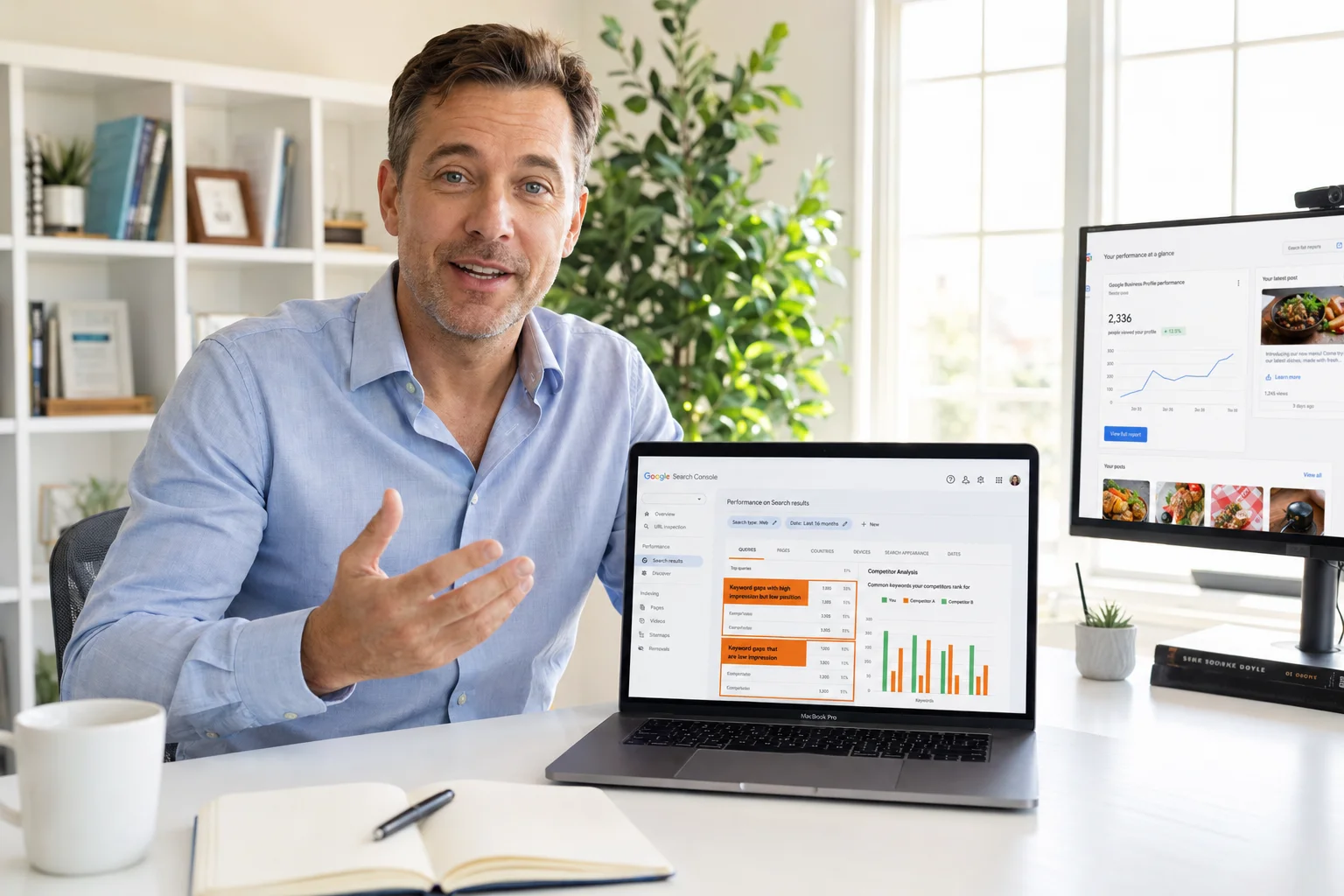
On the site itself, it is a technical SEO audit with the geography turned up
Every location page ships with schema.org LocalBusiness structured data in JSON-LD, built to Google’s LocalBusiness structured data guidance, with a self-referencing canonical tag, a single-hop 301 redirect for anything retired, and internal linking from the service pages that already carry authority. Pages are held to the published Core Web Vitals thresholds on mobile, and where we build the site ourselves that means static site generation in Next.js with edge caching on Cloudflare, so the CDN does the work instead of a caching plugin. We run an accessibility audit against WCAG at the same time, because a location page a screen reader cannot use is a location page a share of your customers cannot use either.
Where a rebuild or a replatforming is involved, the URL mapping and the redirect map get written before anything moves, not after somebody notices the calls stopped. And when a page gets the traffic but not the calls, a heatmap and one session recording usually answer it faster than another round of A/B testing.
What lands in your inbox each month
- Calls from the profile and from the site, tracked as GA4 events rather than guessed at.
- Direction requests and clicks through to your site from Google Maps.
- Form submits with their real source, so paid and organic never get credited to each other.
- Review count, average rating, and response rate for the month.
- Which location pages Google Search Console shows as indexed, and which it dropped.
- Core Web Vitals field data for the pages that matter, not a one-off Lighthouse score.
Reports are assembled from your own Google Business Profile, Google Search Console, and GA4 data. We do not have a proprietary metric, because a number only we can calculate is a number you cannot check.
Built for the way your customers search
Every local market has its own search behavior. We tailor your profile, reviews, and content to how your buyers actually look for you.
Home services
HVAC, roofing, plumbing, and electrical. You live on "near me" and reviews, so we get your trucks into the 3-pack across every neighborhood you cover.
Dental & medical
New-patient searches start on Maps. We tune your profile, reviews, and location pages so you show up the moment someone nearby needs care.
Law firms
High-intent local searches and practice-area pages, backed by the reputation signals that win the click in a crowded market.
Restaurants & retail
Hours, photos, menus, and a steady stream of fresh reviews. The signals that turn a Maps search into foot traffic.
Real estate
Neighborhood-level content and agent-profile authority so you own the searches buyers and sellers actually run.
Med-spa & wellness
Treatment and "near me" searches plus before-and-after review proof, so bookings come to you instead of the chain down the road.
The engine that earns the top spot
After your profile, reviews are the strongest map-pack signal there is. We build a system that keeps fresh, genuine reviews coming and answers every one, so your rating, recency, and review keywords all work in your favor.

Real specialists, not a listings mill
I run your strategy myself, so the person who scopes your local SEO is the person accountable for the results. Returns on your time, not just your spend.
- Founder-led strategyNot handed to a junior team
- Local SEO experts, consultants & specialists500+ businesses served
- Profile, reviews, and authorityThe full map-pack engine, in one place
Questions, answered like a real call
How much do local SEO services cost in the US?
US local SEO retainers run about $500 to $3,000 a month, according to WebFX. The main drivers are how competitive your market is and how many locations you have. FactoryJet scopes every engagement to the work that will move your map-pack rankings and calls, then quotes a fixed price up front on a short call so you know the full cost before work starts. The simplest way to get a real figure is to start with a free local SEO audit.
Do you lock me into a long contract?
No. Every FactoryJet engagement is month-to-month. If we are not earning our keep, you can leave with one billing period of notice. The work should retain you, not the paperwork.
What do I get from the free local SEO audit?
A full review of your Google Business Profile, citations, reviews, and the competitors beating you in the map pack, plus a prioritized 90-day local roadmap. It is a complete picture of why you are not ranking and what to fix first, and you walk away with it whether or not you continue.
Do you offer local SEO services for small businesses?
Yes. Local SEO services for small businesses are a core part of what we do, and we keep them affordable by focusing on the handful of profile, review, and citation fixes that produce the most calls first, instead of a long invoice of busywork. Single-location owners are welcome.
How do I choose the best local SEO company?
The best local SEO companies do four things well: optimize your Google Business Profile, build genuine reviews, keep your citations consistent, and earn local links. Ask any local SEO consultant or expert to report results in calls and bookings, not rankings, and to work month-to-month so they have to keep earning it.
What does local SEO with FactoryJet include each month?
We optimize and post to your Google Business Profile, build and respond to reviews, keep your citations consistent, and publish local content and links, then report the calls and bookings it produces. No filler tasks padded onto an invoice.
Do you manage my Google Business Profile directly?
Yes. We tune your categories, services, attributes, photos, posts, and Q and A, and keep the profile active. Your Google Business Profile is the single biggest lever for the map pack, so it gets the most attention.
Do you handle reviews?
Yes. We set up a system that brings in a steady flow of genuine, keyword-rich reviews and respond to them on-brand. Review quantity, recency, and sentiment are among the strongest local ranking signals there are.
What are citations, and do they matter?
Citations are mentions of your business name, address, and phone across directories and aggregators. We make sure they are consistent and free of duplicates, because inconsistent listings quietly hold back your map-pack rankings.
Will you build a website or fix my current one?
Usually we optimize what you have, adding location and service pages where they help. If your site is too slow or cannot be crawled, we can rebuild it in about seven days at a 100/100 Lighthouse score, but that is a recommendation, never a forced upsell.
How long does local SEO take to work?
You will usually see a first measurable lift in the map pack within 30 to 90 days from profile and citation fixes, with momentum compounding by month four to six as reviews and authority build. Anyone promising the top of Maps in a week is selling something that will not last.
Do you guarantee the top of the map pack?
No honest local SEO company can guarantee a specific position, because Google controls it and proximity to the searcher is part of the math. What we guarantee is the work, full transparency, and a strategy designed to compound over time.
How do you report results?
You get a monthly report in plain language tied to calls, direction requests, and bookings, not a wall of keyword positions nobody acts on. You will always know what we did and what it produced.
What if I do not see results?
We review progress every month and adjust the plan. Because the engagement is month-to-month, you are never trapped paying for work that is not moving the numbers.
What is the Google map pack and why does it matter?
The map pack is the block of three businesses Google shows on Maps and at the top of local searches. Those three capture the overwhelming majority of calls and direction requests, so being in it is the whole game for a local business.
What actually decides map-pack rankings?
Google weighs three things: proximity to the searcher, relevance to the query, and prominence from reviews and links. The biggest controllable levers are your primary category, your reviews, and consistent citations, which is exactly where we focus.
Can you help me rank in "near me" searches?
Yes. "Near me" is the dominant pattern in local search now. We optimize your profile, content, and citations so you surface for "SEO near me," "local SEO near me," and every other "near me" search across your whole service area, not just the block your office sits on.
How important are reviews for local ranking?
Very. Google looks at your overall star rating, the number of reviews, how recently you received them, and even the words customers use. A steady flow of fresh, genuine reviews is one of the strongest signals you can build.
Do you optimize for "near me" AI Overviews too?
Yes, lightly. When Google answers a local query with an AI Overview, it pulls from the same profile, review, and authority signals we already build for the map pack. Keeping those strong keeps you eligible to be the business it surfaces.
What is Google Maps SEO?
Google Maps SEO is the work of ranking your business inside Google Maps and the map pack. It is the same discipline as local SEO: your profile, reviews, citations, and local authority decide where you appear when someone nearby searches "near me."
Do you handle multi-location businesses?
Yes. We manage profiles, location pages, and citations across all your locations, keeping each one consistent and individually optimized so every branch competes in its own map pack.
Which industries do you work with?
We get results for home services like HVAC, roofing, and plumbing, dental and medical practices, law firms, restaurants and retail, real estate, and med-spa and wellness businesses across the US.
Do you work with service-area businesses that have no storefront?
Yes. Service-area businesses can rank in the map pack without a public address. We set up your profile correctly for the areas you serve and build the local signals that get you found across them.
Who will I actually be working with?
The founder, Bhavesh. The person who scopes your local SEO is the same person accountable for your results, not a junior who rotates off the account next quarter.
Who is the best local SEO company in USA?
For single- and multi-location SMBs, FactoryJet makes a strong case: founder-led engagements, transparent, fixed-price quotes, and Map Pack work done by the same engineers who fix your site's technical foundation. Published lists of the top 10 local SEO services in USA are a fine starting shortlist, but the best local SEO services in USA share three measurable traits: they manage your Google Business Profile weekly (not quarterly), they build local citations that AI engines also read, and they report calls and direction-requests, not just rankings.
Find out why you are not in the map pack
Book a free local SEO audit and a 20-minute call with the founder. We will show you exactly why your competitors are outranking you on Maps and what to fix first. No junior reps, no pressure.
- A real audit, not a sales pitch
- Covers your profile, reviews, and citations
- 4.9 / 5 average Google review rating